
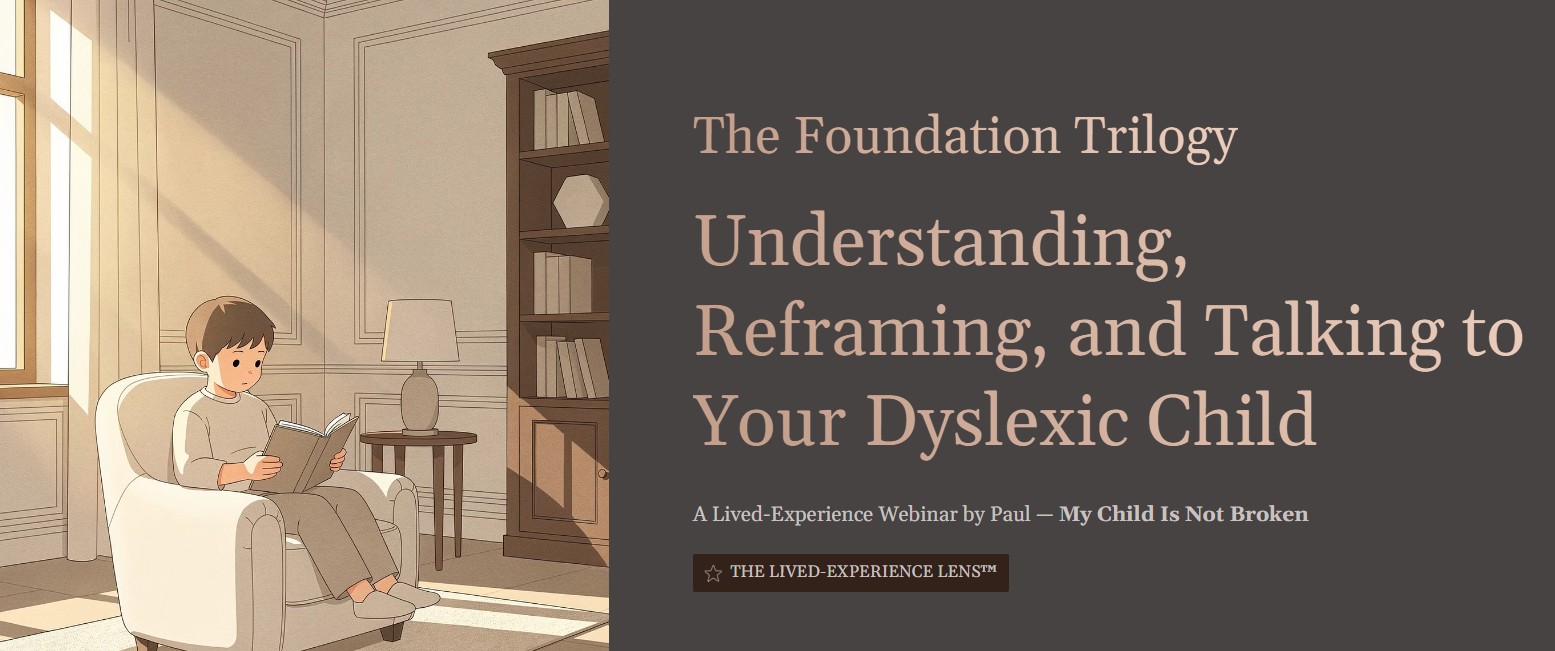
"My Child Is Not Broken" →
A video micro-course that helps parents of dyslexic children go from guilt-ridden and confused to genuinely understanding their child's unique brain WITHOUT wading through clinical jargon, expensive assessments, or outdated advice from people who've never lived it."
Mum am I Stupid?
Speaker
The Best

— Paul Foster
Dyslexic Business Owner
Paul Foster spent years inside a classroom that couldn't explain why he was working twice as hard as everyone around him — and still falling behind.
Nobody gave him the truth about his brain. So he carried the wrong story about himself for longer than he should have.
He went on to earn a First Class BSc in Computer Science and IT, build his own business, and create the programme that changes everything — My Child Is Not Broken.
Dyslexic. Business owner. BSc First Class Honours.
Built from the inside. The only lens that truly understands.
Got a Question?
We've got answers
II have the diagnosis report.
I've read it four times.
And I still can't explain to my child — in words that actually reach them — why reading is so hard for their brain.
Not in a way that sounds true rather than kind. Not in a way that gives them something real to hold onto instead of the wrong story they've been building on their own.
If that gap is familiar — the space between having a diagnosis and actually understanding what it means — I built something for you.
60 minutes. Plain English. Built from inside the dyslexic experience.
Dyslexia means seeing letters backwards
This is the most common belief about dyslexia.
It is also completely wrong.
Dyslexia is a neurological difference in the phonological processing pathway — how the brain converts written symbols into sounds. Most dyslexic people do not see letters backwards.
Believing this myth sends parents to the wrong interventions for years.
If they just tried harder, they'd be able to read properly
A dyslexic child reading a paragraph is doing approximately five times the cognitive work of a non-dyslexic child reading the same paragraph.
They are already trying harder than anyone in that classroom.
Asking them to try harder is like asking someone to run faster on a broken leg.
Extra time in exams is enough support
Extra time adjusts the output.
It does not touch the story your child is building about themselves.
The identity work — the part that actually changes outcomes — happens at home, in ordinary moments, with the right words.
That's what this guide gives you.
Dyslexia only affects reading and spelling
Dyslexia affects phonological processing — which underpins reading, spelling, working memory, processing speed, sequencing, time management, and the learning of foreign languages.
A child who struggles to remember a sequence of instructions, tell the time on an analogue clock, or retain what they just read — these are all connected.
Treating dyslexia as a reading problem alone misses the whole picture.
You need a specialist to really help your child
The research is clear: parental understanding is one of the strongest predictors of outcome for a dyslexic child.
Not parental qualifications. Not specialist provision.
Parental understanding.
You are not unqualified. You are irreplaceable.